

Short answer
An AI lead response agent is software that answers an inbound inquiry within seconds on any channel, qualifies it with the questions your sales team would ask, writes the result into your CRM, and books a meeting or escalates to a human. It matters because response time, not lead volume, is the variable most B2B teams are quietly losing on — and it is the one variable you can fix in about a week without hiring anyone.
The gap nobody puts on a dashboard
Ask a sales manager how fast the team replies to a new inquiry and you will hear "same day, usually faster." Then pull the timestamps. In the audits we run, the median first reply on a web form sits somewhere between forty minutes and six hours, and the tail is much worse: anything that lands after 4 p.m. on Friday is answered Monday. Nobody is lazy. The form goes to an inbox, the inbox belongs to three people, and everyone assumes one of the other two has it.
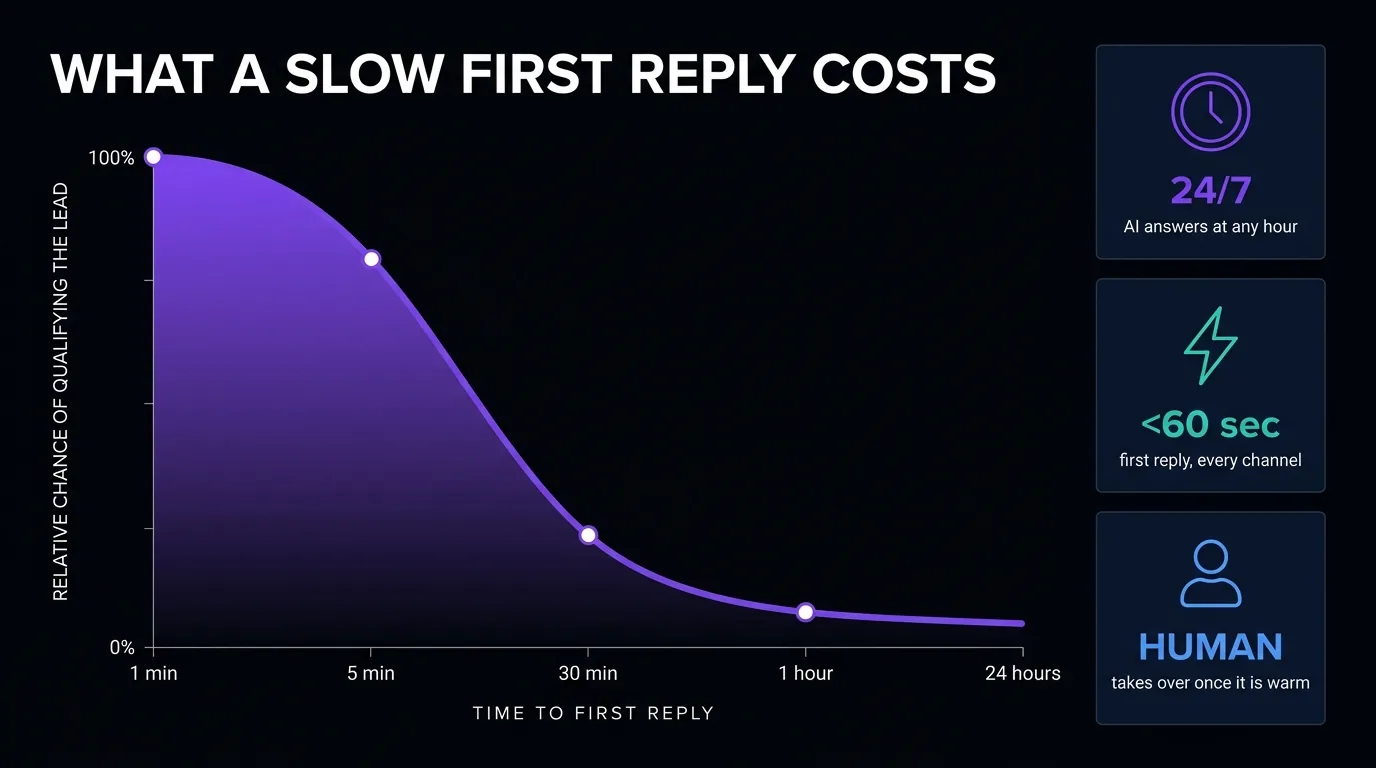
That would be survivable if buyers waited. They do not. In a considered purchase — equipment, a service contract, anything with a quote step — the person filling in your form is filling in two or three others in the same sitting. First substantive reply gets the conversation. Not the best price, not the best website. The first one that answers the actual question.
The uncomfortable part is that this is not a sales-skill problem, so training will not fix it, and it is not a traffic problem, so more ads will make it worse. It is a coverage problem. Somebody has to be awake, and for a company of eight people that somebody cannot be a person.
Worth checking before you read further
Send yourself an inquiry through your own form, right now, from a phone you do not normally use. Note the time. Do the same on WhatsApp and on the chat widget. Whatever number comes back is your real first-response time — not the one in the CRM report, which only counts leads someone eventually touched.
What the agent actually does, step by step
Stripped of the marketing, a response agent runs five moves. Each one is boring on its own. The value is that they happen in eleven seconds instead of eleven hours.
- Catches the inquiry wherever it lands. Web form, live chat, WhatsApp, Telegram, Facebook and Instagram messages, a shared mailbox, or a call that went unanswered and turned into a text.
- Answers the question that was actually asked. Not "thanks for reaching out, a manager will contact you." If someone asks whether a 30 kW inverter will work with their existing panels, it answers from your own spec sheets, and says so.
- Qualifies with two or three questions. Volume, timeline, whether they already have a supplier — whatever your team asks on a first call. Asked conversationally, one at a time, not as a form.
- Writes structured data into the CRM. Company, contact, product interest, budget signal, urgency, source — as fields, not as a pasted transcript. This is the part that decides whether your pipeline reports are usable six months later.
- Books or escalates. If the lead is ready, it offers real slots from a real calendar. If it is out of scope, or the buyer sounds annoyed, or the question touches a firm price commitment, it hands over with the whole thread attached.
Try the arithmetic on your own numbers
Below is a deliberately transparent model. It does not know anything about your market and it is not pretending to be research — you set the recovery assumption yourself, and the calculator just does the multiplication that most people never sit down and do.
Response-time leak estimator
This is your assumption, not ours. Set it low if you are skeptical — the number below is still usually larger than people expect.
Where it plugs in
The agent is not a widget you paste on the homepage and forget. It sits between your channels and your CRM, which means the integration work is where the project succeeds or fails. In practice that is the CRM connection — field mapping, deduplication, and deciding what happens when the same company writes from two different addresses. A response agent that creates a duplicate contact on every message is worse than no agent at all, because now somebody has to clean up after it.
On the channel side, most B2B companies need three: the website, one messenger, and email. Which messenger depends entirely on the market — in Germany and Austria it is usually WhatsApp, in Central and Eastern Europe Telegram, in North America plain email and SMS. We cover the mechanics of that split in the piece on channels for B2B outreach.
What it does not do, stated plainly
Every vendor in this category oversells. Here is the honest boundary, and it is the same boundary we write into the scope document:
- It does not replace a salesperson. It replaces the first eleven minutes of a salesperson's day and the follow-up nobody gets around to. The negotiation, the technical objection, the relationship — still human. We wrote a longer version of that argument in where an AI SDR replaces humans and where it does not.
- It does not commit you to a price or a date. Anything binding gets escalated by rule. This is a deliberate constraint, not a limitation we are apologizing for.
- It does not fix a bad offer. If inquiries are dying because your price is out of market or your lead time is twice the competition's, faster replies just deliver the bad news sooner.
- It does not generate demand. This system converts inquiries you already get. If you are getting four a month, fix demand capture first — the agent will not have enough to do.
Reactivating the leads you already paid for
The fastest measurable win is usually not new traffic. It is the list of people who inquired in the last eighteen months, got a quote, and drifted. Nobody called them back because calling back a cold quote is unpleasant and the reply rate is low, which makes it exactly the job to hand to software.
The agent works that list on an approved schedule, with the original context: what they asked about, what they were quoted, how long it has been. Anyone who answers goes to a human immediately. It is a small, unglamorous project — usually two or three days of setup — and it is the one that pays for the rest of the build in the first month, because the cost per conversation is close to zero and the contacts are already qualified.
Sequencing that works
Reactivate the old list first, because it proves the plumbing works on people who already know you. Then turn on live first response. Then, and only then, spend more on traffic. Teams that do it in the reverse order spend three months paying for clicks that land in the same leaky inbox.
How long it takes and what it costs
A website agent trained on your own content is a self-contained build at $950. A full loop — several channels, CRM writeback, qualification logic, follow-up sequences, escalation rules — is the core of an AI Growth Sprint at $2,250, delivered in seven to ten working days on your live traffic rather than a sandbox. The full list is on the pricing page, and the honest starting point is the $750 audit, which exists partly so we can tell people whose numbers do not justify the build.
One thing worth saying about timing: because the agent covers the hours nobody is working, it is the piece that makes a European team viable for North American clients and a small team viable for a market that expects answers at 9 p.m. That is not a side effect. For a lot of our clients it is the entire reason the system exists.