

Short answer
Generative engine optimization is the work of getting your company retrieved, understood and cited by AI assistants when a buyer asks them a question you sell the answer to. It shares its technical base with SEO — crawlability, structure, authority — and departs from it in three specific places: answer-first page structure, a single consistent entity across the whole site, and facts stated concretely enough that a model can quote them without hedging.
What changed, precisely
The search result page did not get worse. It got skipped. When someone asks an assistant "who supplies three-phase inverters in Poland with under four weeks lead time," they are handed a paragraph naming two or three companies. There is no page two. There is no position eleven. You are either in the paragraph or you do not exist for that question.
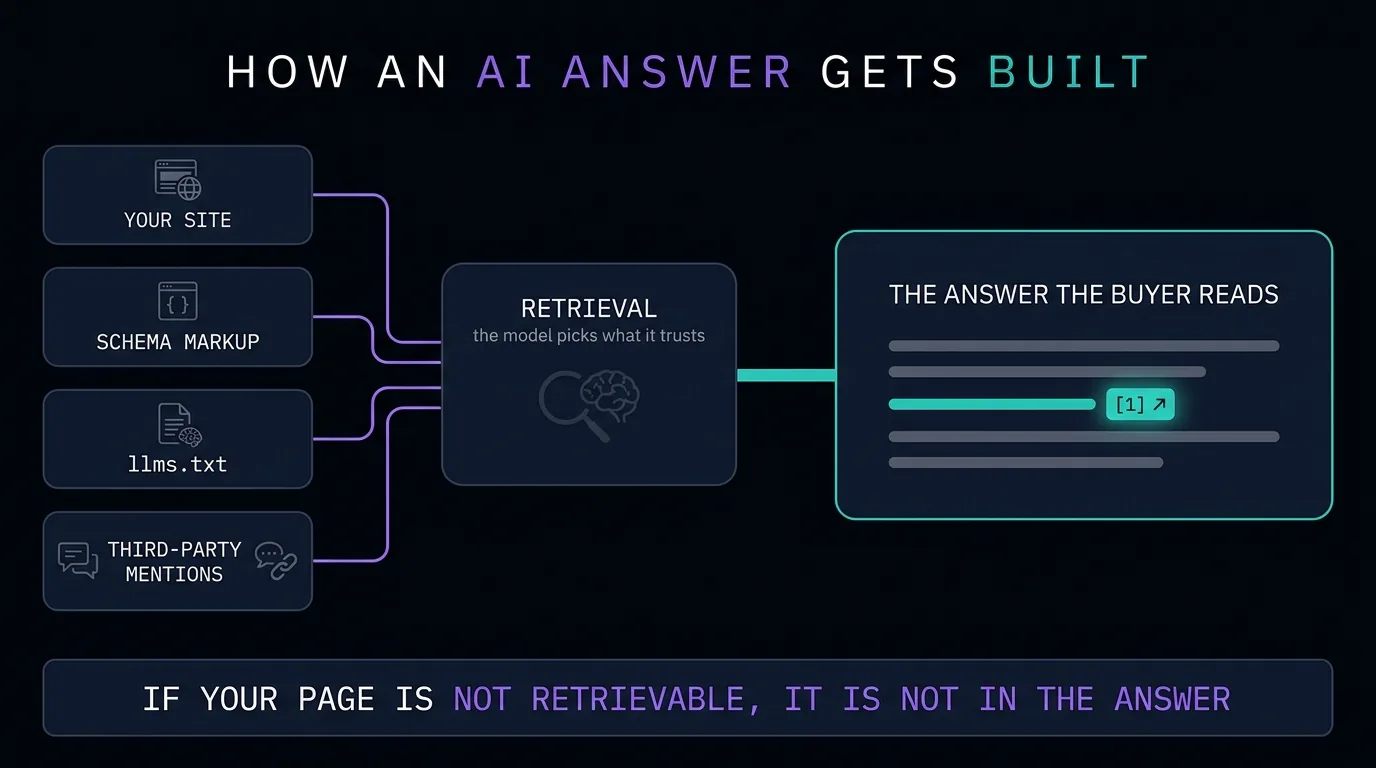
That shifts what optimization means. Ranking was a competition for attention among ten visible options. Citation is a filter: the model retrieves a handful of documents it can reach and parse, discards the ones that contradict themselves or say nothing specific, and composes from what is left. Most of the losses happen at the retrieval and parsing stage, before quality is ever considered — which is oddly good news, because those failures are cheap to fix.
Check your own site before you read our pitch
These eight items cover most of what decides whether a B2B page gets used as a source. Tick what is honestly true today. The score is weighted — the technical items count for more because they are pass-or-fail rather than gradual.
GEO readiness, self-assessed
What the work actually consists of
1. Retrievability, first and non-negotiable
Several of the crawlers that feed assistant answers do not execute JavaScript, or execute it with a budget so small that a heavy single-page app returns an empty shell. If your product copy only exists after hydration, you are invisible to those systems no matter how good the copy is. We check what each crawler actually receives, fix the rendering path, and confirm with a fetch rather than an assumption. This is usually the single largest jump, and it is measured in days.
2. Answer-first structure
A model composing an answer wants a self-contained passage it can lift. Pages that open with a value proposition and reach the substance in paragraph nine lose to pages that state the answer in the first eighty words and then justify it. This is not dumbing down — the depth stays, it just moves behind the answer instead of in front of it. Every page we build carries a marked quick-answer block for exactly this reason, including the one you are reading.
3. One entity, stated the same way everywhere
This is the item most agencies skip because it is invisible without tooling. If your company is described with a slightly different name, a different set of social profiles and a different founder on forty pages, search engines and models resolve that into several weak entities instead of one strong one. Consolidating it is unglamorous — a single identifier, one canonical set of facts, no contradictions — and it changes how confidently a model will name you. We wrote the long version in entity SEO and the knowledge graph.
4. Specifics a model can safely quote
Assistants hedge on vague claims and repeat concrete ones. "Fast delivery" is unquotable. "Ships in four to six weeks from a warehouse in Rotterdam" is quotable. Prices, lead times, capacities, certifications, the size of the team, what you do not do — these are the sentences that end up in answers. Most B2B sites have this information and keep it in a PDF.
5. Presence on things you do not own
Models weight corroboration. A claim that appears only on your own domain is treated as a claim; the same claim on a trade directory, a partner site, a supplier list and a press mention becomes a fact. This is the slowest part of the work and the part with the longest half-life, which is why we start it in month one rather than month four.
6. Machine-readable context
An llms.txt file stating who you are, what you sell, what it costs and where
you operate gives assistants a clean summary instead of making them reconstruct one from
your navigation. It is not a magic ranking file and nobody should sell it as one. It is
cheap, it removes ambiguity, and when a model does read it, it reads exactly what you
wrote. Ours is at /llms.txt if you want to see the shape.
How we measure it, since rank tracking no longer covers it
None of these is a rank. All three move before revenue does, which is the point of a leading indicator. Classic organic positions keep being tracked as well, because the two systems still share most of their inputs and a page that wins citations usually wins rankings a few weeks later.
Who this is not for
- Anyone who needs results this quarter. Retrievability is fast; authority is not. If you need pipeline in six weeks, spend that money on converting the inquiries you already get and start GEO in parallel.
- Sites with no commercial pages worth ranking. If everything is a blog post and there is nothing to buy, there is nothing to cite. We would rebuild the service pages first.
- Companies that want a guaranteed number of citations. Nobody can promise that, and the ones who do are describing branded queries you already own.
Scope, price and the honest entry point
GEO is part of the SEO, GEO & Demand Capture retainer, which starts at $2,750 a month and runs as continuous work rather than a project with an end date. Before any of that, the $750 audit covers retrievability, entity consistency and a prompt-panel baseline, so the decision is made on evidence. The full list of what things cost is on the pricing page, and there is a free analyzer that runs a shallower version of the same checks in about a minute without talking to anyone.
Frequently asked questions
What is generative engine optimization, in plain terms?
Is GEO just SEO with a new name?
How do you measure something with no rank tracker?
Do we need to change the whole website?
How long before anything moves?
What does it cost and can we start small?
Go deeper