

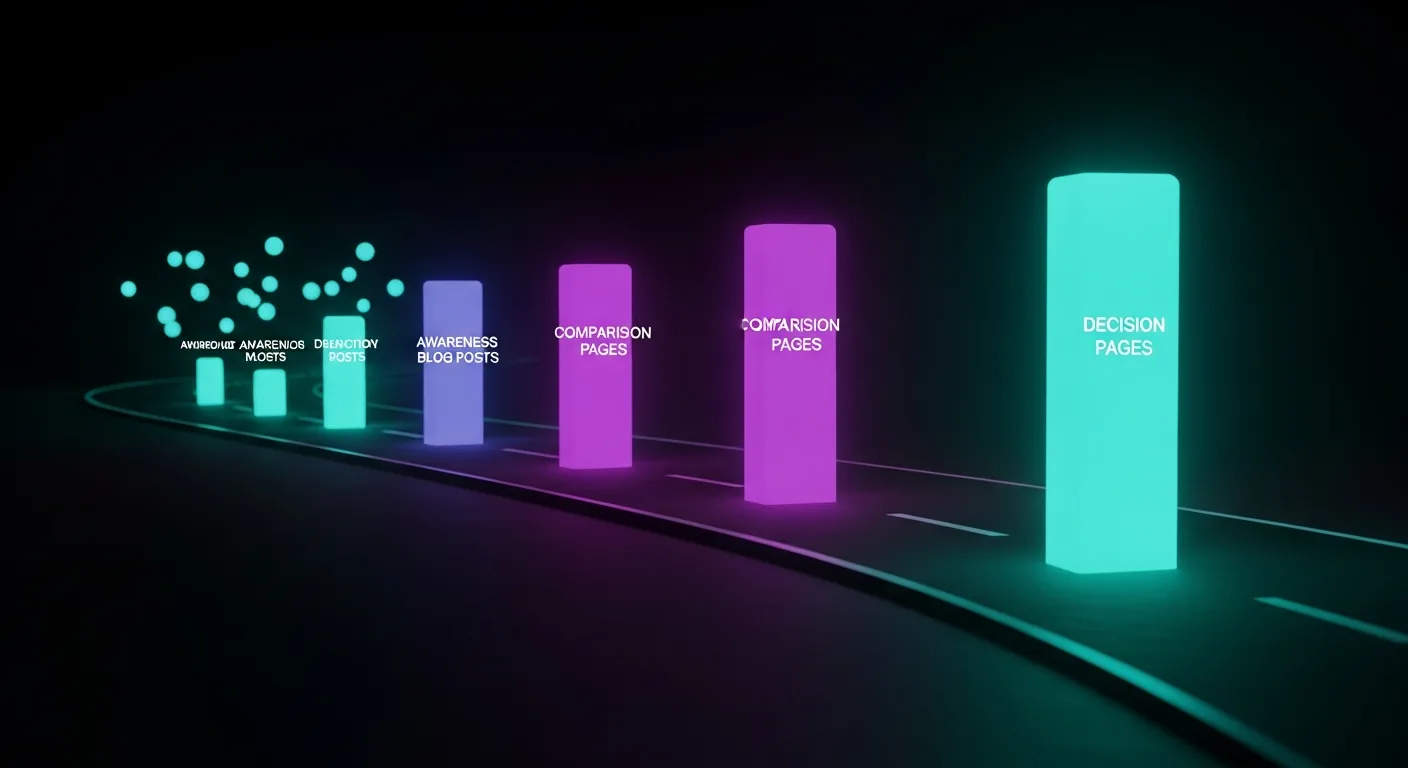
In B2B with a long sales cycle, the winner isn't the one chasing maximum traffic, but the one who correctly distinguishes early research, solution fit, and high commercial intent.
Teams often mistake informational queries for success, while the pipeline is built on much narrower, more commercial signals that initially look like less traffic.
In B2B with a 3-9 month deal cycle, SEO strategy is fundamentally different from e-commerce or consumer services. There's no "bought 3 minutes after clicking". There's a long decision journey where the customer returns to your site 6-12 times, reads 4-7 pieces of content, compares 3-5 vendors, and only then reaches out. SEO for this cycle isn't about capturing instant demand — it's about building trust before the first contact.
Most B2B companies make one mistake: they target only bottom-of-funnel queries (like "buy CRM for B2B"), ignoring the entire journey from problem awareness to decision. The result is narrow semantics, high competition, and little traffic. A proper strategy covers all funnel stages.
The B2B buyer's journey: what queries at each stage
The B2B buyer journey typically has 4 stages, and each generates its own type of inquiry:
- Stage 1 — Problem Awareness: "why the sales team isn't hitting quota", "how to reduce lead leakage", "what to do if marketing isn't delivering". The person only knows there's a problem. That's the top of the funnel — informational queries.
- Stage 2 — Solution Research: "B2B sales automation," "what is a Fractional CMO," "AI for lead handling." People search for approaches and solution categories. Semi-commercial queries.
- Stage 3 — Vendor Evaluation (choosing a provider): "best AI automation agencies USA," "Fractional CMO vs agency comparison," "reviews of [competitor]." Commercial queries are the most valuable for service pages.
- Stage 4 — Decision: "AI sales department cost," "CRM audit request," "marketing pilot project." Transactional searches with the highest conversion rates.
"A company that meets a potential customer at the Problem Awareness stage and guides them through the entire journey wins trust before they even start collecting proposals."
Why long-tail beats head terms in B2B
The B2B SEO paradox: the query "CRM for business" gets 10,000 searches a month with 90/100 competition. The query "CRM for a 50-person logistics company with document automation" gets 30 searches and 12/100 competition. But the second converts 40 times better.
The reason: a narrow query signals a specific situation and real intent. Someone searching for "CRM for logistics automation" knows exactly what they need. If your page matches that query, your chances of getting a lead are close to 80%.
- Long-tail B2B formula: [Service] + [Industry/company size] + [Specific task/result]. For example: "Fractional CMO for an IT company of 30-100 people, strategy."
- Geographical long-tail: "AI business automation Kyiv," "growth marketing agency Ukraine" — for local B2B markets, this significantly boosts conversion.
- Pain-based long-tail: "how to stop losing leads in a B2B sales team", "why marketing doesn't generate leads". Pain-based queries have the highest engagement and low competition.
Time to first SEO result: realistic data
B2B SEO is a long-term investment. Here's a typical timeline if done right:
- Months 1-3: Technical SEO audit, fixing errors, optimizing existing pages. First shifts in indexing. Traffic changes slightly.
- Months 4-6: Publishing cluster articles, getting first long-tail rankings. Traffic growth of 20-40%. First leads from organic.
- Months 7-12: Growth in domain authority, rankings for mid-frequency queries. Traffic +80-150%, steady lead flow.
- Year 2+: The SEO channel becomes a full-fledged pipeline source with a CAC lower than paid (typically 3–5x cheaper than Google Ads).
To speed up the process and build SEO in parallel with other channels — See our approach to SEO and Demand Capture.
A long cycle forgives slow growth but not technical holes: a page a crawler cannot see collects no touchpoints across all nine months. The free site analysis surfaces those spots in 40 seconds — before you spend half a year building content around them.
Quick diagnosis
Check off the items you already have. This doesn't replace an audit, but it quickly shows how much control you have over the topic.
Entity block by topic
For a page to work for both people and search, it's important to explicitly name key entities and concepts. This makes the topic denser and the solution clearer, without marketing fog.