

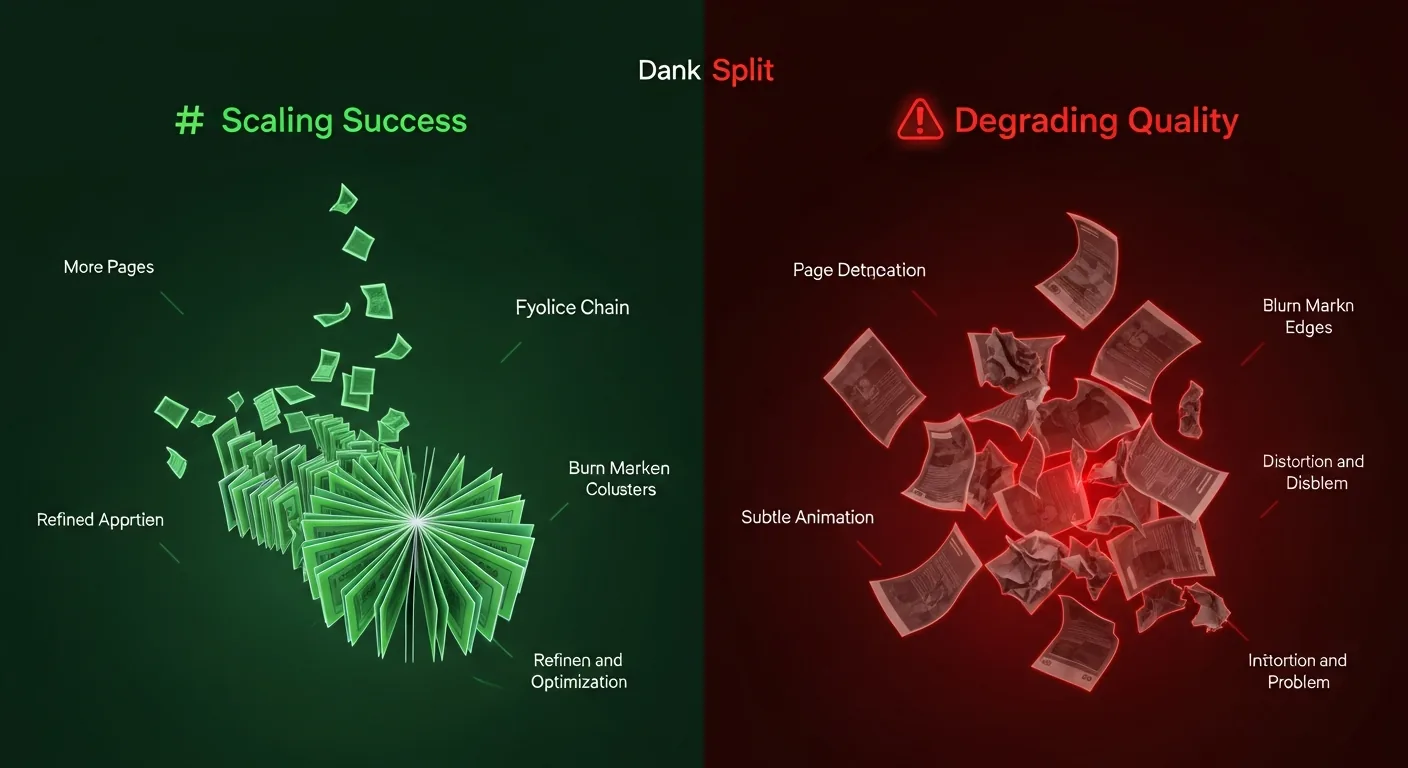
Programmatic SEO is a powerful tool, but in niche B2B it doesn't work everywhere. We break down where it creates an advantage and where it turns your site into a content factory with no sales.
Companies see flashy mass-SEO case studies and try to copy them in a narrow B2B niche, where search volume is lower, intent is thinner, and page quality matters more than quantity.
Programmatic SEO is scaling content with templates and data. Instead of writing each article by hand, you generate hundreds or thousands of pages automatically: "CRM for [industry]", "[Service] pricing in [city]", "[Product A] vs [Product B] comparison". For large marketplaces and SaaS companies, this is a strategy that has driven millions of organic visitors. For niche B2B, it's a trap that can kill your rankings.
Why? Because search engines have gotten smarter. Google's Helpful Content Update (2023-2024) directly targeted mass content factories with no real value. If your programmatic content doesn't answer a specific question better than competitors, it will drag your entire domain down.
When programmatic SEO really saves niche B2B
There are specific scenarios where content scaling wins even in narrow niches:
- Geographic Matrix: If you serve multiple cities or regions—"SEO audit for business in Kharkiv," "Fractional CMO for startups in Lviv." Each page is genuinely unique if it includes local specifics.
- Industry matrix: 'AI automation for logistics,' 'CRM for construction companies,' 'Lead generation for law firms' — if you have real experience in each industry.
- Comparison pages: "HubSpot vs Pipedrive for small B2B" — if you've actually tested both tools and can give an honest analysis.
- FAQ clusters: Automatic generation of pages for queries like "how much does X cost" — if prices really depend on parameters and you display them.
Programmatic SEO works when each page is genuinely distinct from others and delivers unique value for a specific sub-query. If the only difference between pages is a word swap in a template, that's spam, not content.
Where programmatic SEO hurts B2B niche companies
Here are real scenarios where scaling destroys rankings:
- "Empty" pages: Pages with identical copy and only the keyword swapped. Google flags thin content and drags down the whole domain.
- No backlinks: Programmatic pages rarely earn external links organically. Without authority, they don't rank for competitive queries.
- Cannibalization: 500 similar pages cannibalize each other for the same queries instead of reinforcing one strong page.
- Low CTR: Headlines like "Service X for City Y" are boring and don't get clicks — even if they rank in the top.
"After the Helpful Content Update, we saw traffic drops of 40-70% for clients using a programmatic approach without real content differentiation. Recovery took 6-9 months."
The minimum page quality to rank in 2025
If you still want to scale content programmatically, every page must pass this checklist:
- ✓ Unique H1 and title (not just a template)
- ✓ At least 300 words of real content
- ✓ Response to the specific intent of the inquiry
- ✓ At least 1 unique fact/date/figure
- ✓ 800+ words with real examples
- ✓ Structured schema (FAQ, HowTo)
- ✓ Internal link to the money page
- ✓ At least 1 external link to the page
The right approach: quality * scale, not scale instead of quality
For niche B2B, the optimal strategy is not programmatic in the classic sense, but systematized content plan:
- Top 10 client industries × each of your services = 30-50 quality pages (not 500 empty ones)
- Content cluster around the money page: 5-8 blog articles, each supporting one service and linking to it
- AI for efficiency, not replacement: AI drafts, a subject-matter editor from your team adds real experience and case studies.
- Measure by leads, not traffic: 20 pages that each convert — better than 2000 pages with zero leads
Programmatic pages fail quietly: the template renders on the client and the source keeps an empty shell — a hundred pages that exist for people and not for the index. The free site analysis shows how much text is visible without JavaScript. Check that before you generate anything at scale.
Quick diagnosis
Check off the items you already have. This doesn't replace an audit, but it quickly shows how much control you have over the topic.
Entity block by topic
For a page to work for both people and search, it's important to explicitly name key entities and concepts. This makes the topic denser and the solution clearer, without marketing fog.