

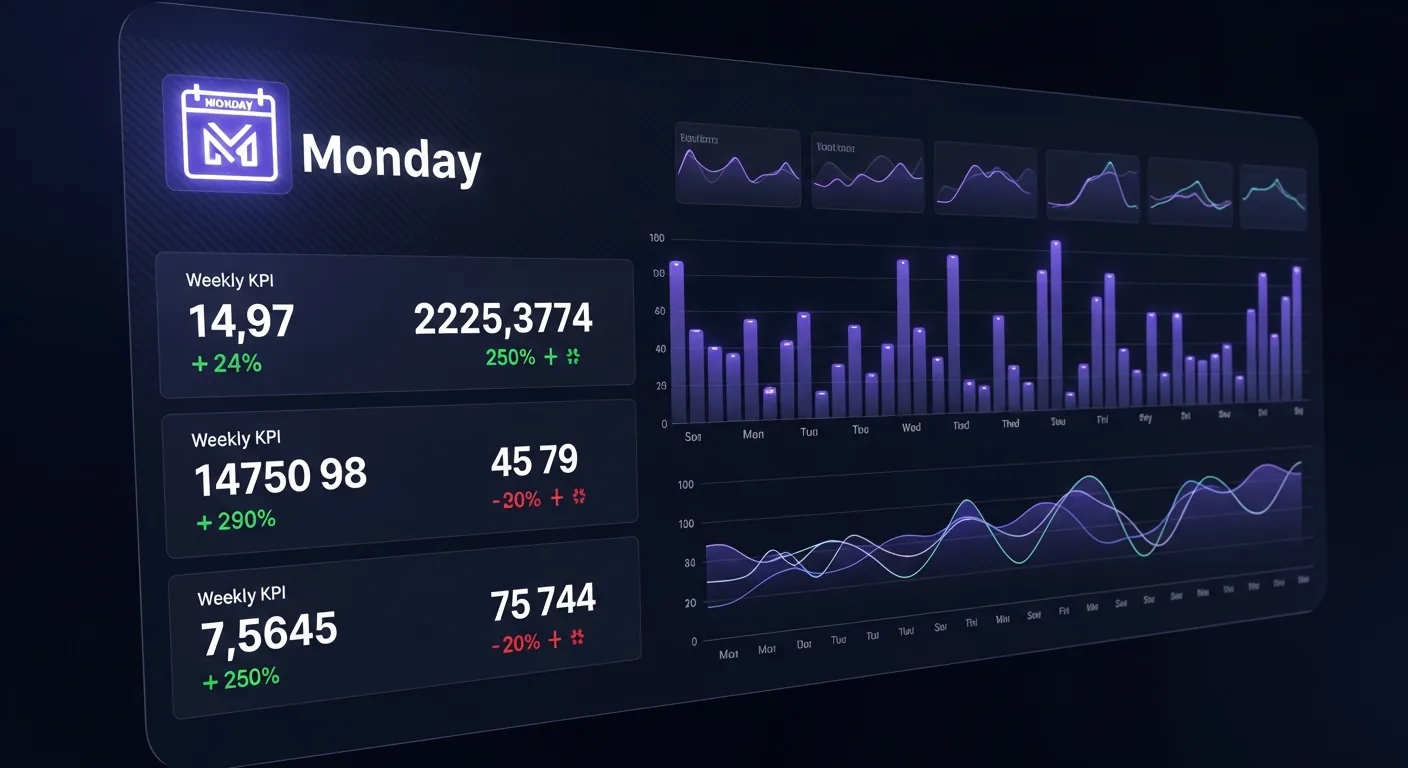
What weekly rhythms, meetings, reports, and decisions are needed so marketing and sales work as one growth system, not as separate departments.
Without rhythm, there's no management. It's either chaos in chat threads or a 'monthly recap' when it's too late to fix anything.
Most marketing reports we see at clients share one problem: they look backward and say nothing about the future. "In February we had 340 clicks, 12 leads, CPL $28" — and what do you do with that on Wednesday? What decision does it suggest? None. A report is not management. Management is when you look at the numbers and know exactly what to do next week to change the outcome.
Why most marketing reporting is useless
We regularly audit marketing systems in B2B companies and see three types of reporting that equally fail to drive growth:
- Vanity metrics: reach, followers, CTR, number of posts. These numbers look nice in presentations but have no direct link to revenue.
- Backward-looking reports: Monthly summaries that arrive on the 5th of the following month. By the time you read them, the problem has been growing for a week.
- Reports without decisions: "Here's what happened" without "here's what we do next." If a report doesn't end with concrete actions, it's just taking up your time.
An effective weekly control system, by contrast, is built on the reverse principle: first we define which decisions we want to make each week, and only then — which numbers are needed for those decisions.
5 weekly dashboard metrics that actually matter
For a B2B company with active sales, we recommend a dashboard with five key metrics. No more — otherwise it's not a dashboard anymore, it's an analytics system nobody uses.
- Pipeline velocity (funnel speed): How many new deals entered the pipeline this week and their total value. This is a leading indicator — it shows what revenue will look like in 4-8 weeks.
- CPL by channel: cost per lead for each active channel. Without that number you don't know where the money goes. With it, you can reallocate budget in real time.
- SQL conversion rate: What share of this week's leads became qualified for sales. If this metric drops while CPL stays stable, the problem isn't marketing — it's traffic quality or qualification.
- Deal cycle (time to close): the average number of days from first contact to decision. If this time is growing — either the market has cooled or your nurturing is breaking.
- Churn / expansion: whether current customers are growing or churning. For most B2B companies, retention is 60% to 80% of revenue. If that number isn't in the dashboard, you have a blind spot.
"A dashboard should answer the question: 'What are we doing differently this week?' If nothing changes after looking at the numbers, the dashboard isn't doing its job."
Monday rhythm: a 30-minute review template
We use a fixed cadence: every Monday, 30 minutes, with one shared dashboard for marketing and sales. Here's the sequence that stuck with our clients:
- Minutes 1–5: pipeline for the past week. How many new deals, what total value, what closed (won/lost). No details — just numbers.
- Minutes 5–10: marketing metrics. CPL by channel, number of new leads, MQL→SQL conversion. If there is a deviation from targets — a short "why".
- Minutes 10–20: where it gets stuck. Specific deals or leads that aren't moving. What it takes to get them moving. Who's responsible.
- Minutes 20–30: decisions for this week. What we stop, what we scale, what we launch. Max 3 items — otherwise nothing gets done.
A critical detail: this rhythm must be protected from "let's skip this once." A week without a review is a week without managed decisions. Over a month, that turns into drift.
How to set up automated reporting without an analyst
For most B2B companies with teams up to 30 people, an analyst is a luxury. But a weekly dashboard can be automated with minimal resources. Here's a practical setup:
- CRM as the single source of truth for sales metrics. Pipedrive or HubSpot with configured funnel fields. No parallel spreadsheets — all data lives only there.
- Google Sheets as a dashboard. Through the Google Sheets API or via Make/Zapier, the CRM automatically pushes data to a spreadsheet every week. Setup takes 4–6 hours, once.
- Marketing data from ad accounts. Meta, Google Ads, LinkedIn — each has an API or ready-made connectors for Google Sheets. CPL is calculated automatically.
- Automatic reminder on Monday. Slack or email with a link to the dashboard and a review reminder. Without that, the rhythm falls apart in 2–3 weeks.
How to connect marketing metrics to sales team behavior
The most common mistake is marketing and sales looking at different things and meeting only to figure out who's to blame for a bad month. Weekly review solves this not through "more communication" but through a shared frame of reference.
Concretely: if SQL conversion drops below 25%, marketing and sales together review lead quality by channel. If the deal cycle grows from 21 to 35 days, sales explains where deals are stuck, and marketing checks whether there's nurturing content for that stage. If CPL on LinkedIn rises 40%, the budget reallocation decision is made next Monday, not next month.
This synchronization is one of the key functions of a Fractional CMO: keeping marketing and sales in the same rhythm and ensuring decisions are made on shared data. More on this role — Fractional CMO page.
Fractional CMO
An external management function for the owner: strategy, priorities, vendor oversight, KPIs, and a growth system — without hiring an in-house CMO.
Quick diagnosis
Check off the items you already have. This doesn't replace an audit, but it quickly shows how much control you have over the topic.
Entity block by topic
For a page to work for both people and search, it's important to explicitly name key entities and concepts. This makes the topic denser and the solution clearer, without marketing fog.