


A site can rank perfectly in Google and still not exist for ChatGPT, Claude or Perplexity. There are two causes, both invisible from a browser, and both close for a fixed fee.
What breaks the result is that no report warns you. Rankings hold, traffic does not drop, and a share of your buyers simply stops arriving, because the shortlist was drawn for them inside a chat.
What you are losing while nothing hurts
A plant manager needs a 200 kW UPS. Instead of comparing vendor sites, they type one request: who supplies this, with prices and lead times. They get three names, a short table and one recommendation. Then they write to those three.
In that scenario you did not lose on price or terms. You were not in the room when the decision was made. And you cannot find out: there is no visit, no bounce, nothing at all.
In energy and industrial B2B one such deal is tens of thousands of dollars. So the question is not how much traffic you get, but whether a model includes you when the buyer is already ready to purchase.
- What changed: the shortlist now forms inside an assistant answer rather than a page of ten links.
- Why it stays invisible: the buyer never visited, so there is no lost session to find in analytics.
- Who is most exposed: considered purchases with long evaluation, where people ask for comparisons rather than addresses.
Open any assistant and type the request your customers arrive with. If you are not in the answer, you have just seen your real visibility.
Why Google sees you and ChatGPT does not
It reads like a contradiction, but the mechanics are simple. Google opens a page almost like a person: it runs the scripts, waits for everything to draw, and sees the finished screen. Assistants mostly do not. They take what the server handed over immediately and move on.
So a site where prices, specifications and tables are drawn in the browser looks complete to classic search and empty to a model. Rankings do not fall, which is exactly why this is the last thing anyone checks.
- Classic search: renders the page and sees what you see.
- Assistants: mostly read only what arrived from the server in the first response.
- The consequence: two different pictures of one site, and you only ever look at the better one.
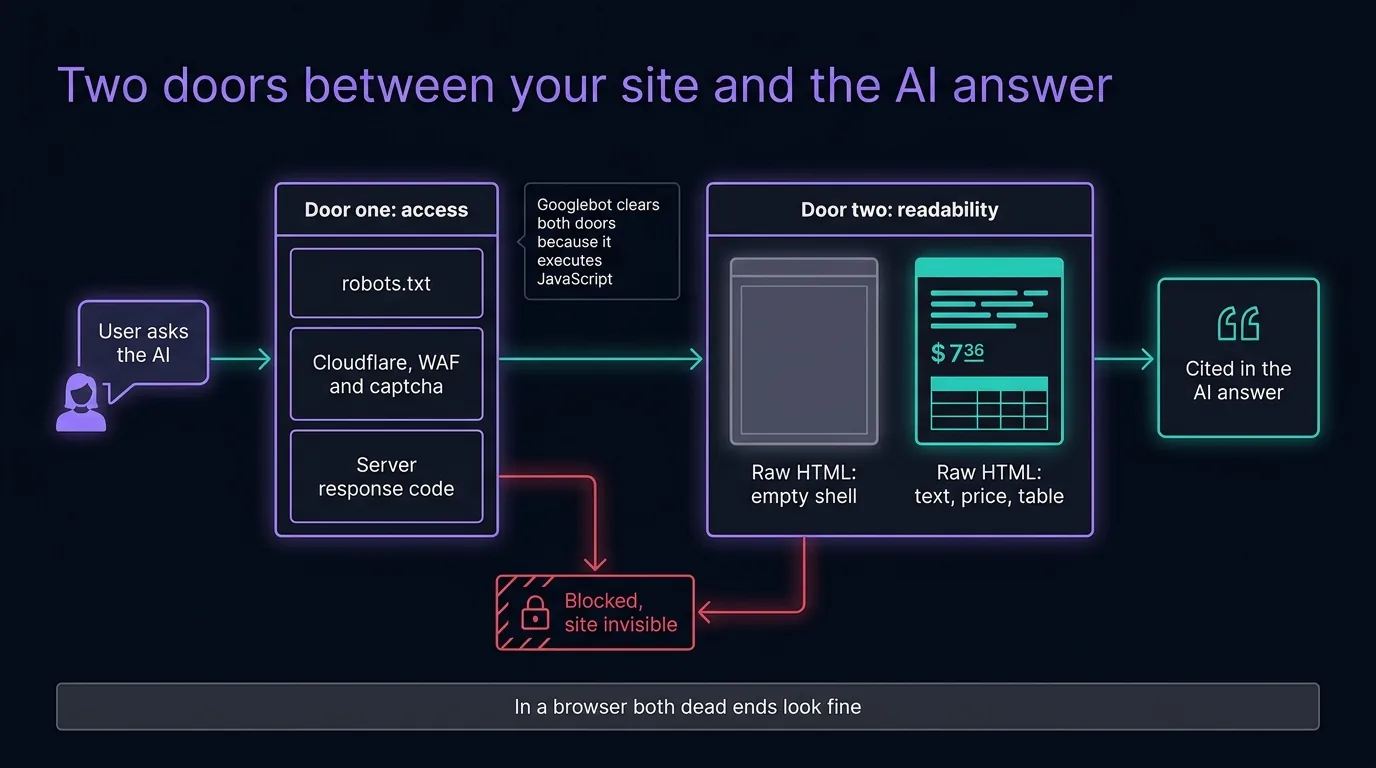
The cheapest check there is: open the page source and search it for the price of your flagship product. If it is not there, the model does not see it either.
Two causes, and neither is visible from a browser
First cause: you were not let in. Robot rules on the site, bot protection at the hosting layer, settings in the security edge. These decisions were often made in passing years ago, and the consequence only surfaced now that assistant traffic became material.
Second cause: you were let in and there was nothing to read. The page arrives as an empty shell and the useful text appears later. For a buyer it is perfect. For a model it is a blank sheet.
The difference matters in money. The first is a configuration job of half a day. The second is work on how pages are assembled, which costs more and removes the problem permanently.
- The symptom is identical: everything looks fine in Google, and you are absent from assistants.
- First cause: access. Fast, inexpensive, verifiable in minutes.
- Second cause: an empty page source. More expensive, and it is the reason a competitor is in the answer while you are not.
Check the first cause before the second: it is cheap and it often solves half the problem.
Six questions about your site that an owner can answer without a developer. Shows which zone you are in and where to start.
Calculated from your answers, not from a measurement of the site. For real numbers, run the free analysis.
15 September 2026: the date after which some sites disappear on their own
On 1 July 2026 Cloudflare, which fronts a large share of the web, announced new rules for AI traffic. From 15 September some sites begin blocking bots automatically, with no action from the owner.
The detail that disappears first in retellings is the condition. The new defaults apply to pages that display ads, and indexing for search stays allowed. So an equipment catalog with no ad blocks, which is most of B2B, does not fall under the automatic block.
Others are exposed: free plans where nobody ever opened the settings, new domains, and new sites inside existing accounts. If that is you, the date matters.
- What to do now: open the security edge settings and set the rules explicitly instead of leaving them on automatic.
- Who is unaffected: paid plans with their own settings, and sites without ad blocks.
- The cost: half a day of work before the date, and an unknown amount of loss after it.
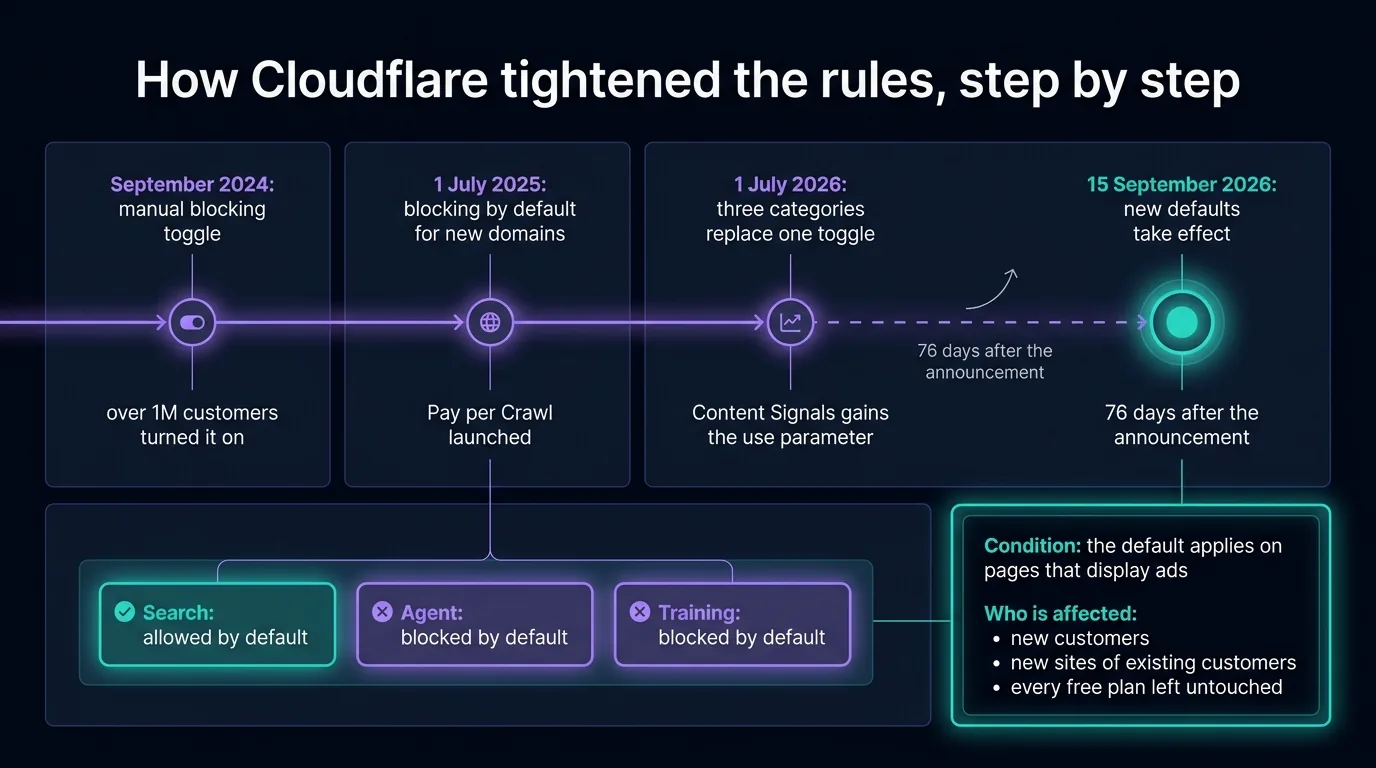
Count the days left and put this in the calendar this week, not in October.
Four questions about your hosting and your site. Instead of reading announcements you see immediately whether the new defaults apply to you.
The acronyms you are being invoiced for
The market has learned to sell letters. Here is the translation into plain language: what each one means and which of them is worth paying for. If a vendor uses them without this level of specificity, the problem is the vendor rather than the terminology.
Half of these words describe the same thing in different ways, and that is fine. The disciplines are genuinely separate. The revenue they produce is not.
- Classic search: SEO, SERP, Search Intent, LSI, Backlinks, Crawl Budget: SEO is the fight for a place in a list of links, and the SERP is that page of results. Search Intent is what sits behind the query: is the person pricing or still learning. LSI covers the related words a system uses to place your topic. Backlinks are links to you from other sites. Crawl Budget is the ceiling on how many pages a robot will fetch, and on a large catalog it runs out sooner than your patience.
- Speed: Core Web Vitals, LCP, INP, CLS: Three metrics Google uses to measure how a site feels. LCP is when the main block appeared, INP is how fast the page reacts to a tap, CLS is whether the layout jumps under a finger. Together they are Core Web Vitals, and they move both rankings and conversion.
- Machine-readable data: Schema.org, Entity SEO, Knowledge Graph: Schema.org is the markup that tells a system directly: this is a company, this is a service, this is a price. Entity SEO is when you are known as an entity rather than a bag of words. The Knowledge Graph is the fact base that entity lives in. Without this you are a random site to an algorithm, not a recognized name.
- AI answers: GEO, AEO, AIO, LLM SEO, Zero-Click: GEO optimizes for the answer itself rather than the list. AEO is the same from the format side: a short direct answer that can be quoted whole. AIO is used as a synonym for GEO, and LLM SEO is narrower, about a specific model. Zero-Click is a query that ended without a visit, and that is precisely what takes your traffic.
- How a model reads text: NLP, Semantic Search, Vector Embeddings, Context Window, RAG: NLP is the umbrella term for language processing. Semantic Search matches meaning rather than literal words. Vector Embeddings turn meaning into numbers so it can be compared. The Context Window is how much text a model holds at once, which is why long unstructured pages read worse. RAG is when a model answers from your documents rather than memory, and it is what removes invented prices.
- Scale: Programmatic SEO: Generating hundreds of templated pages from data: city, service, equipment model. It works where demand splits into narrow queries and it hurts where the pages come out thin.
Do not try to buy every letter at once. Ask your vendor which one they close first, and why that one.
What we do and what it costs
We do not sell a subscription to hope. Each cause is closed by a separate package with a fixed price, so you can see what you are paying for.
Presence in AI answers, $450, covers access and structure: robot rules, a machine-readable company summary, and key answers shaped so a model can quote them whole. Server-side rendering, $900, addresses the second cause: prices, specifications and tables start arriving with the page instead of after it.
Alongside them people usually take the technical search base and the company-as-an-entity markup, $350 each. If the whole loop is needed at once, that is a Pilot Sprint of 10 working days with a working result at the end rather than a report.
- Presence in AI answers: $450. Access, machine-readable summary, quotable structure.
- Server-side rendering: $900. Prices and specifications become visible to models.
- Technical base and entity markup: $350 each. The foundation without which the first two deliver less.
- Pilot Sprint: 10 working days when it all has to close at once.
- Ongoing generative optimization: from $3,000 per month, when the result has to be held rather than reached once.
Start with one package rather than the whole loop: in eight cases out of ten the first one already closes the expensive gap.
A check that takes one minute
You do not have to take our word for it and you do not need to buy an audit to learn where you stand. We packaged these checks into a free tool: it opens your page the way a model opens it and reports measurements.
It deliberately gives no advice and invents no numbers it did not measure. Whatever cannot be seen from a single request is listed separately, so you do not make decisions on a guess.
- 40 checks in 40 seconds: no signup and no email.
- Measurements, not advice: what exists, what does not, and what this test cannot see.
- Prices attached: if a gap is found, you see what closing it costs.
Enter your domain and look at your own site the way a model does. The decision gets obvious after that.
You do not have to run this check by hand. Our free site analysis opens your page with a single request, without executing JavaScript, and shows what a crawler actually sees. Forty checks in forty seconds, no signup.
Check your site